


Summary
Head control refers to using grips, pressure, and positioning to control your opponent’s head and neck. In grappling, the head follows the spine, so when you control the head, you control the body.
It is one of the most important yet often overlooked fundamentals in Brazilian Jiu-Jitsu. It helps you control distance, manage posture, and dictate the pace of a roll. Good head control allows you to break posture, restrict movement, and create openings for sweeps or submissions. It’s a concept used in every position, from clinch entries to ground transitions.
Whether you’re fighting while standing, in top position, or working from guard, proper head control gives you leverage over your opponent’s body movement.
This article explains what head control is, why it matters, and how to use it effectively in your BJJ game.
Key Takeaways
- Head control is one of the most important fundamentals in Brazilian Jiu-Jitsu because controlling the head allows you to influence your opponent’s entire body.
- It helps you manage distance, break posture, and create openings for sweeps and submissions in every position.
- Effective head control improves your ability to dictate the pace of a roll whether you are standing, on top, or working from guard.
Why Head Control Matters
In BJJ, posture determines power. If your opponent’s head is tilted, turned, or forced downward, they can’t generate force effectively.
Here’s why mastering head control is valuable:
- Limits Mobility And Visibility: When you control not only the head, but you can even potentially control their field of vision, with their heads faced away, you can sneak in a submission/guard break without your opponent knowing.
- Breaks Posture: Useful in both guard and top control situations.
- Sets Up Submissions: Many chokes and joint locks rely on controlling head alignment. Think of the rear naked choke and front headlock, once you have control of their head, it’s more or less a guaranteed homerun.
- Improves Positional Dominance: It helps stabilize transitions and pins.
Learning to manage your opponent’s head and neck gives you an advantage in almost every grappling exchange.
Using Head Control From Different Positions
1) From The Closed Guard Bottom Position
In closed guard or half guard, controlling your opponent’s head keeps their posture broken, making it harder for them to strike, pass, or stand.
Sometimes, you may find yourself in the bottom position. Although it may look unfavorable at first, you can still control your opponent by using your arms and a strong collar grip. With one hand on the collar, use your free hand to shield your head, as demonstrated by BJJ Master John Danaher. This not only helps you manage their posture and head movement but also protects your own head from pressure and potential counters. Once you establish solid control from the Closed guard, you can begin transitioning into attacks such as the triangle or guillotine, turning a defensive position into an opportunity to submit your opponent.
The key is to maintain consistent tension without overexerting your arms.
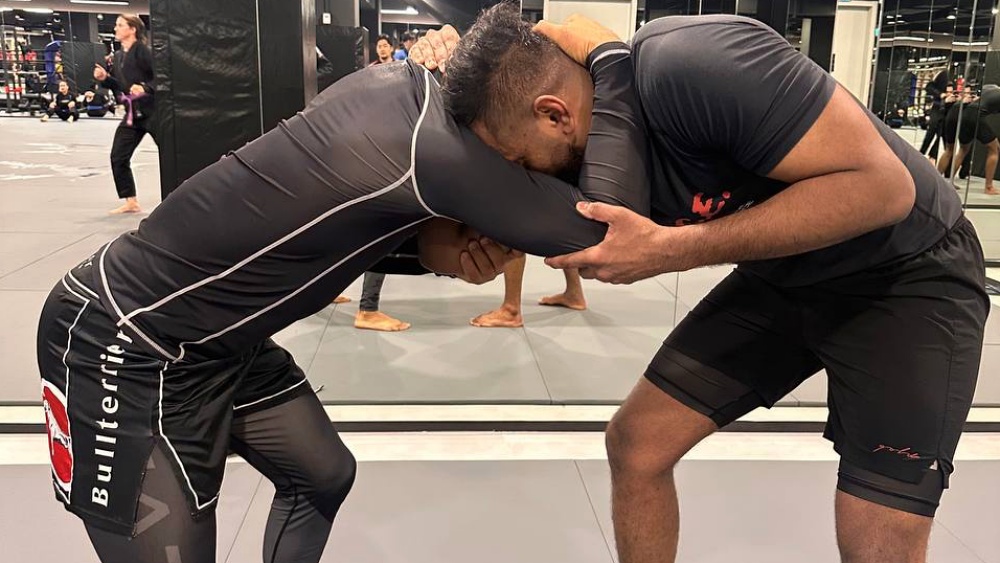
When standing, head position determines inside control. Keeping your opponent’s opponent’s head under control helps you drive pressure and maintain posture during takedown exchanges.
For example, in a No-Gi exchange where you are trying to secure a body lock or an underhook, you can switch to a collar tie to slow your opponent down and control the flow of the battle. From the collar tie, you can set up a snapdown to break their posture and create openings for front headlock attacks, takedowns, or transitions to dominant positions.
Tip: Keep your arms close to your body. Reaching too far forward can expose you to reversals such as arm drags
The front headlock is one of the best positions to demonstrate head control. You use your arms and shoulder pressure to control your opponent’s posture and direct their movement.
From here, you can attack guillotines, anaconda chokes, or transition to back takes. Proper weight distribution and constant head pressure make it difficult for your opponent to escape.
Other Ways To Improve Head Control
- Develop Strong Neck And Shoulder Muscles: Strength and stability around the neck improve your ability to hold and resist pressure. Include neck bridges and resistance band drills in your conditioning routine.
- Stay Connected: Maintain head-to-head or shoulder-to-head contact during scrambles and transitions. This keeps your connection tight and prevents sudden escapes.
- Learn Pressure Control: Apply firm but steady pressure. Excessive force wastes energy and may create openings for counters.
- Drill Positional Awareness: Practice scenarios where you alternate between top and bottom positions while maintaining head control. Focus on adjusting angles rather than muscling through.
- Combine With Grip And Hip Control: Head control works best when paired with solid grips and hip pressure. Think of it as part of a system, not an isolated technique.
Common Mistakes To Avoid
- Relying Only On Strength: Head control is about positioning, not squeezing.
- Losing Connection: Having space between you and your opponent can potentially result in you losing control. With pockets to slip in/out of and leverage on certain movements, your opponents can get out of your control with even the tiniest opening.
- Poor Posture: While controlling your opponent, be aware of your own posture as well. If your own head drops too low, you might become vulnerable to chokes.
- Neglecting Movement: Static pressure without any progressive movements makes it easier for opponents to frame out. Always plan on the next movement rather than staying in one position.
- Ignoring Angles: Effective control requires adjusting head placement with your opponent’s movements.
Avoiding these mistakes keeps your control efficient and energy-saving during rolls.
Drills To Practice Head Control
- Positional Control Drill: Work from side control or mount, focusing on keeping your opponent’s head pinned with minimal effort. Switch roles every minute.
- Front Headlock Flow Drill: Transition between front headlock, guillotine setup, and back take smoothly. This builds awareness of control points.
- Clinch Pummeling With Head Position: Practice pummeling for underhooks while maintaining inside head position. Focus on how small head movements affect balance.
- Guard Posture Break Drill: From the closed guard, practice pulling your partner’s head down and keeping it controlled while transitioning into submissions.
These drills reinforce sensitivity, balance, and timing, all of which are key ingredients for effective head control.
FAQs On Training Head Control In BJJ
Q: Why Is Head Control So Important In BJJ?
A: Because controlling the head gives you control over the opponent’s spine and posture, which limits their mobility and attack options.
Q: Is Head Control Used In Both Gi And No-Gi?
A: Yes. The mechanics are the same, though grips differ. In Gi, you can use collars; in No-Gi, you rely more on head position and pressure.
Q: What Submissions Work Well From Strong Head Control?
A: Guillotines, arm triangles, anaconda chokes, and d’arce chokes all benefit from good head control.
Q: How Can I Make My Head Control Stronger?
A: Train your neck, practice staying connected, and refine your pressure and angle control through drills.
Final Thoughts
Head control is one of the quiet fundamentals that separates good grapplers from great ones. It gives you the ability to dictate movement, maintain pressure, and transition effortlessly between positions.
Whether you’re defending, attacking, or passing guard, mastering head control helps you stay one step ahead. The more you refine your awareness and connection, the easier it becomes to dominate with precision and composure.
You may also like:
BJJ 101: Breakfalls

Summary To many Brazilian Jiu-Jitsu practitioners, Lachlan Giles represents more than high-level skill. He represents thoughtful problem-solving, innovation, and the idea that technique can overcome size. His performances and teachings helped reshape how grapplers approach…
Summary The Harai Goshi is a fundamental throw in judo and a highly effective takedown used in Brazilian Jiu-Jitsu and MMA. It is recognized for its smooth sweeping motion and the power that comes from…
Summary Whether you train BJJ or wrestling, the body lock takedown works well against a wide range of opponents. Instead of shooting for the legs, you secure tight control around the torso, use angles to…
Summary In Brazilian Jiu-Jitsu, a trip is a standing technique used to unbalance (Kuzushi) your opponent and take them down by targeting their legs. Unlike powerful judo throws that lift or launch an opponent, trips…
Summary A breakfall, known as ‘ukemi’ in Japanese martial arts, is one of the first techniques students learn in Brazilian Jiu-Jitsu. Instead of resisting a fall, you guide your body toward the mat and use…
Summary The Seoi Nage, also known as the shoulder throw, is one of Judo’s most iconic and widely practiced techniques. The name literally translates to “shoulder throw” (Seoi meaning “to carry on the back,” and…
Summary Childhood is full of big emotions. Kids experience excitement, frustration, joy, confusion, and stress as they learn about themselves and the world. Emotional awareness is the ability to recognize and understand these feelings. It…
Summary The new year is the perfect time to reset your routine and start building healthier habits. While many people focus on diets, short-term challenges, or gym memberships, martial arts offers something deeper. It strengthens…
Summary In recent years, celebrity boxing and crossover fights have become common. Fans enjoy high-profile matchups, unusual pairings, and big personalities sharing the ring. Jake Paul has been at the center of this trend, taking…
Summary Enkh-Orgil Baatarkhuu has emerged as one of the most captivating figures in modern MMA. Drawing from his Mongolian roots and the country’s rich combat sports heritage, he has steadily built a name for himself…
Summary Modern MMA continues to evolve with fighters borrowing from different martial arts and adapting unique techniques to fit the sport. The snake kick is one of these creative strikes. It is not as common…
Summary Muay Thai is known for powerful strikes, but defense is just as important. Good defense is not passive. It sets up counters, controls range, and keeps you calm under pressure. Defensive combinations in Muay…